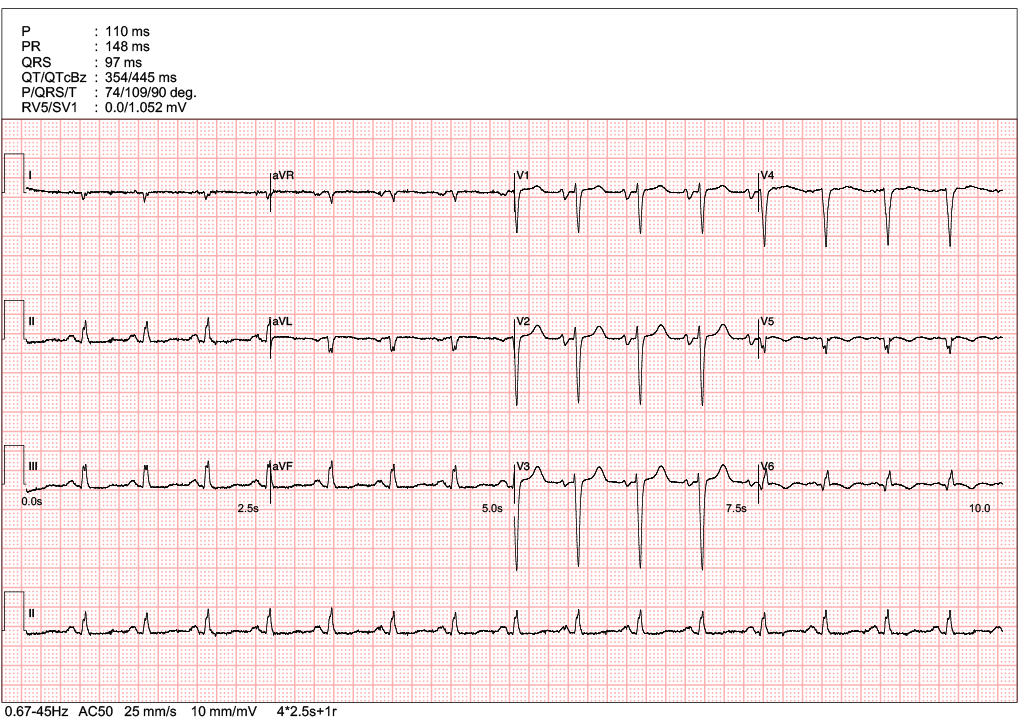
A 50-year-old man presented to the AED with acute chest pain, irregualr heart beats and dizziness today. His BP was 100/50 mmHg and SpO2 was 97% on room air.
Which of the following statement is correct?
Choose the correct answer.
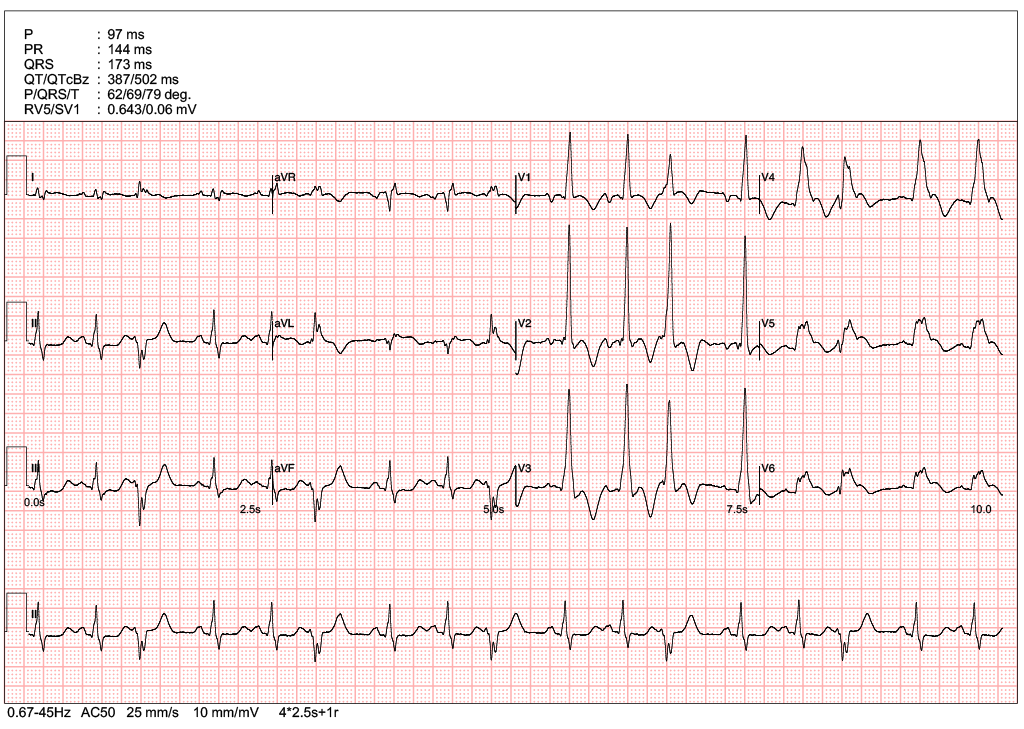
The presenting ECG shows ST-segment elevation in leads V4-V6, accompanied by reciprocal ST-segment depressions in the inferior leads (II, III, aVF) on natively conducted QRS complexes.
The presence of the reciprocal changes significantly enhances diagnostic specificity for a true STEMI, as the widening of QRS complexes in V4-V6 may otherwise mask the diagnosis of ST elevation
egarding the rhythm, clearly discernible P waves are present throughout the tracing, conclusively ruling out atrial fibrillation. Additionally, the documented QT interval prolongation should be recognized as a common secondary consequence of acute, ischemic myocardial injury rather than being assumed to indicate a primary drug-induced or congenital long QT syndrome. While taking a detailed medication history is a necessary component of the clinical workup for QRS widening, this investigative step must not delay immediate activation of primary PCI.
The coronary angiogram showed an acute total occlusion of the mid-LAD, which is consistent with apical transmural ischemia, especially in the context of a rotated heart.
A post-PCI ECG is attached to evaluate for theexpected ST-segment resolution and confirm successful reperfusion.