A 33-year-old woman was referred to your clinic for an abnormal ECG found during a regular health check. Her blood tests including renal and liver function tests were normal. Her past medical history was unremarkable.
Which of the following statement is correct?"
Choose the correct answer.
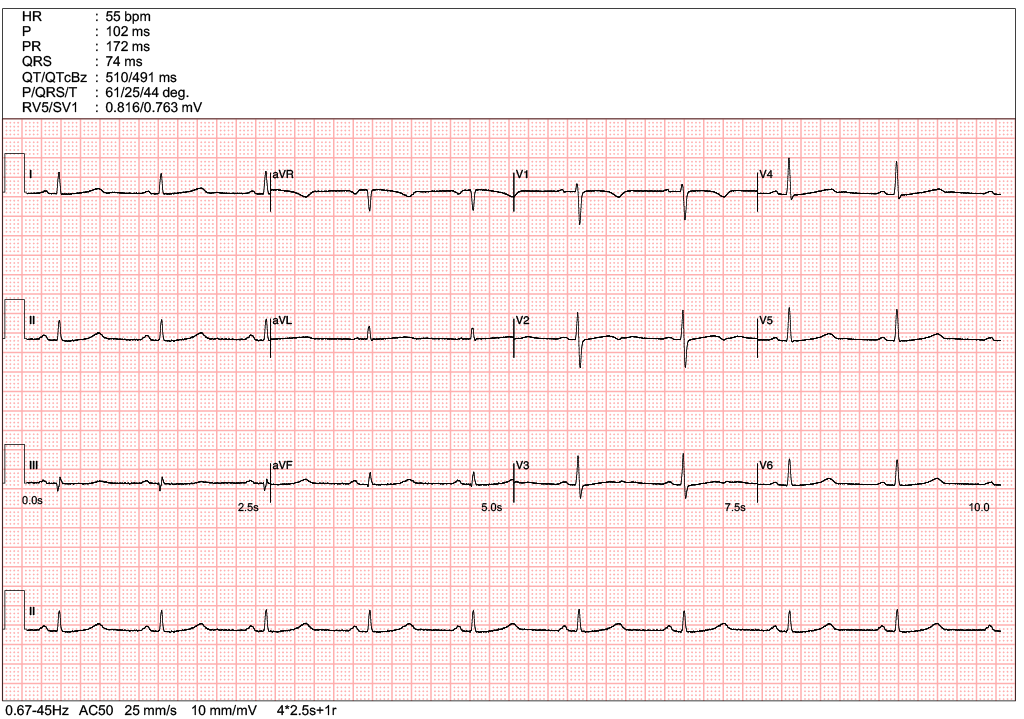
This is an ECG in normal sinus rhythm. The QT interval is prolonged with a QTc of 491 ms.
Acute ischemia may prolong the QT interval, but it is usually accompanied by new ST changes and compatible clinical symptoms. The QT interval is not affected in chronic coronary syndrome or ARVC
Diagnosis of congenital long QT syndrome requires one of the following:
1. QTc ≥480 ms on repeated 12-lead ECGs
2. Schwartz Score ≥3.5 points
3. Pathogenic variant in a LQTS gene, irrespective of QTc duration
Careful inspection of the ST segment revealed a slurred early onset of the T wave instead of an isoelectric ST segment, which is suggestive of LQT1 genotype. A subsequent gene panel revealed a likely pathogenic (LP) variant of KCNQ1 [c.509A>G, p.(Glu170Gly)].
More details on Long QT syndrome can be found at:
https://www.cardiologywiki.com/